That pipe froze last January. And the January before. Now the forecast is dropping again, and you want it to stop. You want to get through a cold snap without checking the kitchen tap every hour.
When your pipes keep freezing in the same spot, the cause is in that spot.
Here's how to find the cause and what a lasting fix looks like in a Burlington, Oakville or Hamilton home. Is a pipe frozen right now? Start with our frozen pipes guide.
TL;DR
- A pipe that freezes every winter has a cause at that spot. It sits too close to the cold, outdoor air blows on it, or room heat can't reach it.
- Open cabinet doors and pipe wrap help on a cold night. They don't remove the cause.
- A lasting fix moves the pipe into the heated part of your home, puts the insulation between the pipe and the outside, or seals the air leak.
- No water at any tap? The frozen section is likely your water service line.
Why Do My Pipes Freeze When the House Is Heated?
Your pipes freeze because the spot where they run is colder than the room. Your thermostat measures room temperature. It can't detect a freezing pipe inside an outside wall, a sink cabinet or the ceiling above a garage.
Halton Region lists where plumbing is most at risk: near outside walls, in crawl spaces, attics and garages, and in areas with too little heat. A pipe in one of those places can drop below 0°C while your kitchen feels warm.
Why Does the Same Pipe Freeze Every Winter?
The same pipe freezes every winter because nothing about that spot has changed. Look at where the frozen pipe runs. Is it on an outside wall or near a draft? Most repeat freezes have one of four causes.
| Where It Freezes | Likely Cause | What a Lasting Fix Looks Like |
|---|---|---|
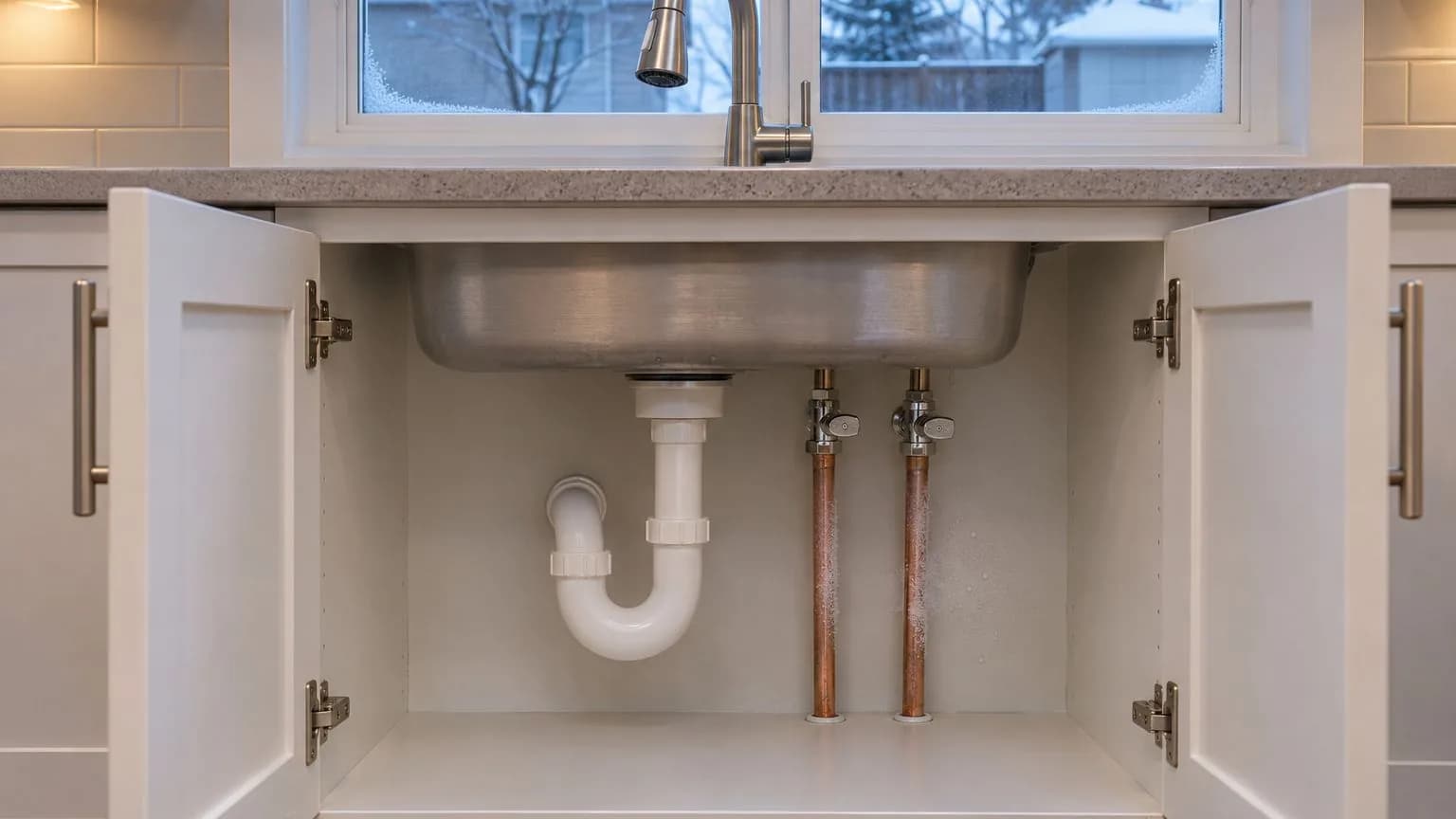
| Under a kitchen or bathroom sink on an outside wall | The water lines run inside the outside wall, and the closed cabinet keeps room heat away | A plumber runs the lines a different way (a reroute), through the floor or an inside wall |
| Inside an outside wall | Insulation sits between the pipe and the room, so the pipe is on the cold side | The pipe moves toward the room, with insulation behind it only |
| Basement ceiling near the outside wall, or where a pipe passes through to outdoors | A gap lets outdoor air blow onto the pipe | A contractor seals the gap, then insulates it |
| Above a garage, in a crawl space or in an addition | The pipe runs through a space with little or no heat | A reroute through heated space, or insulation and heat for that space |

Wind pushes cold air through small gaps, so a pipe can freeze on a windy night that isn't the coldest of the year.

Water that sits still also freezes sooner. That's why a tap you rarely use is often the first to stop.
First, Rule Out a Frozen Water Service Line
If only one tap or room has no water, an indoor frozen pipe is a likely cause. If no tap, shower or toilet has water, Halton Region says your water service line is frozen. A frozen service line is a likely cause, although other water supply problems can produce the same result. So check every tap first.
Who fixes it depends on where it froze.
In Burlington and Oakville, Halton Region looks after the line from the main water pipe under the street to the curb stop, the shut-off valve near your property line. You own the line from the curb stop into your home, plus all the plumbing inside.
If the frozen section is only on your side, Halton charges $663.05 (2026 rate) each time it thaws a 15 to 25 mm line. Halton insulates or buries its own lines that have frozen before. On your side, that job is yours. Call 311 or 905-825-6000.
In Hamilton, the City only responds if the frozen pipe is on the public side of your property. It asks you to have a licensed plumber confirm where the pipe froze before you contact the City. For urgent issues, call 905-546-2489 any time.
Is Pipe Insulation Enough to Stop Pipes Freezing?
Not when the pipe sits in a space that drops below freezing. Insulation slows heat loss. It doesn't make heat. On a long cold night, a wrapped pipe in a freezing wall still reaches 0°C.
Where the insulation sits matters as much as how thick it is.
A Government of Yukon insulation tip sheet says insulation should be fitted behind pipes to prevent freezing. Behind means between the pipe and the outside, so the room's heat can still reach the pipe.
Do Open Cabinet Doors and Dripping Taps Fix the Problem?
They only get you through a cold night.
Opening the cabinet doors under a sink lets room heat reach the pipes. A dripping tap keeps water moving.
Check your local rules first. Halton Region asks you to run water only if the Region contacts you. If you run it on your own, you pay for the extra water.
For more cold-night steps, see our guide on how to avoid burst pipes in winter.
Should You Use a Heat Cable or Switch to PEX?
Neither one fixes the cold spot.
Heat cable can protect a short stretch of pipe that can't be moved. But treat it as a backup. It needs power, so it stops working in an outage.
It also has to suit your pipe material. Have a licensed professional choose it and install it to the product's instructions.
PEX is a flexible plastic pipe. It can stretch a little when the water inside freezes, and copper can't.
But neither pipe is safe from freeze damage. In PEX, the water still freezes, your tap still stops, and fittings can still fail.
How Do You Stop Pipes Freezing on an Exterior Wall for Good?
A plumber moves the pipe, fixes the insulation or has the air leak sealed. Often more than one:
- Move the pipe into heated space. The line comes up through the floor or an inside wall.
- Put the insulation on the right side. A pipe that has to stay in the wall sits close to the room, with the insulation behind it.
- Seal the air leak. A contractor closes the gaps around pipes, vents and the top of the foundation wall.
Ontario's Building Code sets the same goal. Article 7.3.5.3 says piping that may be exposed to freezing conditions must be protected from the effects of freezing.
Who Should You Call, and What Does It Cost?
Start with a licensed plumber. They can find the exact section that freezes, check it for damage and tell you if the pipe needs to move. If the wall needs new insulation or air sealing, you may also need an insulation contractor.
There's no flat price, because the work ranges from small to large:
- Usually the simplest: sealing a gap and insulating a pipe you can see, such as one in an unfinished basement ceiling. If cold air is the only cause, this may be all you need.
- In the middle: a short reroute where the pipe is easy to reach.
- Usually the biggest: moving a pipe inside a finished wall. The wall, and sometimes cabinets or tile, has to be opened and repaired.
We explain the price before any work starts.
Is your home fairly new? Tarion, which runs Ontario's new home warranty, says plumbing pipes must be protected from freezing in line with the Building Code. Its two-year warranty covers defects in a new home's plumbing system. Ask your builder or Tarion if your home qualifies before you pay for a repair.
Watch for Leaks After a Freeze
A pipe that froze can leak later. Ice can crack a pipe, and you may see no sign of it while the pipe is frozen. The leak shows up once the ice melts and water flows again.

After any freeze, watch that spot for drips, damp drywall or a stain on the ceiling below. If you see water, close your main water shut-off valve and follow our steps for what to do if your pipes burst.
Has your pipe frozen more than once? We highly recommend you get a licensed plumber to check it.
Stop the Freeze Before the Next Cold Snap
You don't have to spend another winter opening cabinet doors and hoping. Once a plumber fixes the cause, you can stop checking that tap every time the temperature drops.
Is a pipe frozen or burst right now? Call our 24/7 frozen and burst pipe team: Burlington 905-332-8222, Oakville 905-842-6222, Hamilton 905-545-4222.
Not an emergency? Our licensed and insured plumbers can find out why your pipes keep freezing, and explain the fix before work begins. Book before the deep cold arrives.